Recently the PhD candidate in my lab, Colin Garroway, along with our supervisor and other collaborators published a paper "Climate change induced hybridization in flying squirrels" in the journal Global Change Biology (see abstract/PDF here).
This is big news for climate change proponents... two species of flying squirrel at their respective northern and southern range boundaries have been shown to be hybridizing. The range boundary of southerns has been moving north with climate change, and therefore has increased the contact between the two species. This could in effect reduce biodiversity as two species merge to become one.
Anecdotely, I had southern and northern flying squirrels using the same nest tree at the same time, though I could never find the cavity and therefore I could not confirm if they were using the same cavity or not.
But more importantly, this story is not restricted to the academic journal. It has been featured on the Trent University website.
It is slated to appear in the Globe and Mail, and they have been in contact with science television programmers. This is great! Getting the story out to the public, those who influence change (since climate change is a policitically controlled issue) is critical. I'm glad the that the communications offices at Trent and MNR understand this and make an effort to publish these stories!
Thursday, June 18, 2009

Thursday, June 11, 2009
Wanted: A productive work environment
Graduate student offices have a reputation for being crappy. Crappy location, crappy desks, crappy ventilation, the list goes on. But here at the university who shall remain nameless they are especially bad.
Now that's an exaggeration. The old university buildlings have nice grad student offices, they even have windows! It's the new buildling that seems to have been built with a lack of foresight. The major grad student office is in the middle of the building, surrounded by classrooms and offices on all sides. So no windows. NO NATURAL LIGHT. How do they expect people to work without natural light? That must be an OHS issue (note to self: look up OHS regs).
At other universities I have visited, supervisors have an office and a lab, often in close proximity, where their grad students work/have desks. I like that idea because then the students develop a working relationship with the other students in their lab, and always have access to their supervisor. On the other hand, your supervisor would then ALWAYS have access to you.
That's the one thing I like about this windowless office full of corralled grad students. ONLY grad students have keys to this office, so there's no way your supervisor can sneak up behind you and catch you on Facebook... for the third time... this morning.
When it's all said and done, these offices aren't all bad. But, since I'm moving into a house with an open concept office (with windows on 3 of the 4 walls), I may just move my desk home. That way I can know the weather without having to look it up online!
Now that's an exaggeration. The old university buildlings have nice grad student offices, they even have windows! It's the new buildling that seems to have been built with a lack of foresight. The major grad student office is in the middle of the building, surrounded by classrooms and offices on all sides. So no windows. NO NATURAL LIGHT. How do they expect people to work without natural light? That must be an OHS issue (note to self: look up OHS regs).
At other universities I have visited, supervisors have an office and a lab, often in close proximity, where their grad students work/have desks. I like that idea because then the students develop a working relationship with the other students in their lab, and always have access to their supervisor. On the other hand, your supervisor would then ALWAYS have access to you.
That's the one thing I like about this windowless office full of corralled grad students. ONLY grad students have keys to this office, so there's no way your supervisor can sneak up behind you and catch you on Facebook... for the third time... this morning.
When it's all said and done, these offices aren't all bad. But, since I'm moving into a house with an open concept office (with windows on 3 of the 4 walls), I may just move my desk home. That way I can know the weather without having to look it up online!
Sunday, June 7, 2009
Cold feet... warm heart?
One thing I try to avoid while doing fieldwork is getting cold. It makes everything seem longer and more trying when you are cold. If you are warm, you can go all day in the winter and enjoy being outside. It's not so easy if your hands or feet are freezing.
On that note, I'm not sure why winter hikers for men and women are so different, but I can tell you that men's hikers seem to be made with much higher quality than anything I can get for myself. After working in snow for a month in 'winter' hikers (and consequently, freezing my feet for a month), I broke down and bought snowboots. Huge rubber bottomed leather topped boots with a removable liner - they showed promise.
I worked with the PhD student often, tracking squirrels all day in the snow. Me in my honkin' snowboots and him in his winter hikers. Me in huge overall snowpants and him in lined khakis with gators. Me in a huge winter jacket and him in a light raincoat. Me in a hat and him with a bare head. Basically I was dressed for a blizzard and he was dressed for cool fall weather. Guess who ALWAYS got cold and started to complain? Guilty as charged.
Besides his man hikers, the other thing he wore that I envied were a pair of long leather mitts. They were from Mark's Work Wearhouse and I developed a false hope that maybe, just maybe, they would carry them in an x-small or small. I finally broke down and dropped by Mark's after one extra-frosty day in the woods. I found the mitts and searched the sizes. Medium and larger... probably all sold out I thought to myself. So I found an employee and asked to get a pair in - apparently Medium is the smallest size. Who makes mittens from a M up? Men's mitten companies, obviously.
So, to date I have not found comparable products... but I keep the hope that I was not the only woman requesting comparable winter hikers and mittens, and that maybe that information will get passed on to the powers that be. Maybe then women can get some decent winter work clothing.
On that note, I'm not sure why winter hikers for men and women are so different, but I can tell you that men's hikers seem to be made with much higher quality than anything I can get for myself. After working in snow for a month in 'winter' hikers (and consequently, freezing my feet for a month), I broke down and bought snowboots. Huge rubber bottomed leather topped boots with a removable liner - they showed promise.
I worked with the PhD student often, tracking squirrels all day in the snow. Me in my honkin' snowboots and him in his winter hikers. Me in huge overall snowpants and him in lined khakis with gators. Me in a huge winter jacket and him in a light raincoat. Me in a hat and him with a bare head. Basically I was dressed for a blizzard and he was dressed for cool fall weather. Guess who ALWAYS got cold and started to complain? Guilty as charged.
Besides his man hikers, the other thing he wore that I envied were a pair of long leather mitts. They were from Mark's Work Wearhouse and I developed a false hope that maybe, just maybe, they would carry them in an x-small or small. I finally broke down and dropped by Mark's after one extra-frosty day in the woods. I found the mitts and searched the sizes. Medium and larger... probably all sold out I thought to myself. So I found an employee and asked to get a pair in - apparently Medium is the smallest size. Who makes mittens from a M up? Men's mitten companies, obviously.
So, to date I have not found comparable products... but I keep the hope that I was not the only woman requesting comparable winter hikers and mittens, and that maybe that information will get passed on to the powers that be. Maybe then women can get some decent winter work clothing.
Wednesday, June 3, 2009
Do I have permission to trap?
Trapping on or near private land is always interesting. I trapped on both public land (which was surrounded by cottages) as well as in a private sugar stand. Both situations had their benefits (and disadvantages).
Trapping on public land that is so close to property owners means their interest is instantly peaked. And yes, informing the public about research is very important. But EVERY day, EVERY time you go to do field work having to explain yourself and what you're doing (until each individual resident is informed) can be a bit time consuming. You'd figure, with human nature, that word would get around about what you're doing and why you're there... And then there's the dog owners who think it's a great idea to follow your trapline with their dog as their afternoon walk (which is obviously conducive to catching squirrels).
On private land it's a bit easier, as you explain yourself to the owner once and that's taken care of. BUT neighbors like to keep an eye on each other's property, and then send the cops in to check it out if there's a vehicle they don't recognize on the farm next to them. I speak from personal experience. Luckily I was wearing my Trent University t-shirt and pink rubber boots, so I looked pretty harmless... and the cop was really only interested about how the turkeys were in the sugar stand (apparently he hunts them there - I assume when he's off duty).
AND then there's the men who stop (usually when I'm parked on the side of the road with my field truck, getting ready to track my squirrels or check my traps) to ask me if I need any help. Because a girl can't just stop on the side of the road and walk into the forest... she MUST be in distress.
Or the gas station attendant, who assumes I am harvesting the squirrels for their furs!?!?! Honestly, these things are smaller than chincillas.
But overall, I usually get along ok. I don't ever have to worry about having to replace a flat tire or being broken down. Someone will always stop. Somedays it's good to be a girl :)
Trapping on public land that is so close to property owners means their interest is instantly peaked. And yes, informing the public about research is very important. But EVERY day, EVERY time you go to do field work having to explain yourself and what you're doing (until each individual resident is informed) can be a bit time consuming. You'd figure, with human nature, that word would get around about what you're doing and why you're there... And then there's the dog owners who think it's a great idea to follow your trapline with their dog as their afternoon walk (which is obviously conducive to catching squirrels).
On private land it's a bit easier, as you explain yourself to the owner once and that's taken care of. BUT neighbors like to keep an eye on each other's property, and then send the cops in to check it out if there's a vehicle they don't recognize on the farm next to them. I speak from personal experience. Luckily I was wearing my Trent University t-shirt and pink rubber boots, so I looked pretty harmless... and the cop was really only interested about how the turkeys were in the sugar stand (apparently he hunts them there - I assume when he's off duty).
AND then there's the men who stop (usually when I'm parked on the side of the road with my field truck, getting ready to track my squirrels or check my traps) to ask me if I need any help. Because a girl can't just stop on the side of the road and walk into the forest... she MUST be in distress.
Or the gas station attendant, who assumes I am harvesting the squirrels for their furs!?!?! Honestly, these things are smaller than chincillas.
But overall, I usually get along ok. I don't ever have to worry about having to replace a flat tire or being broken down. Someone will always stop. Somedays it's good to be a girl :)
Wednesday, May 27, 2009
And now I'm writing, writing and writing some more
I haven't written anything since I got back from CSEE '09 because I've been incredibly busy doing and redoing modelling selection for my squirrel nests. Logistic regression + AIC by hand (and by hand I mean excel spreadsheet) is time consuming. And even more so when you input values as words and not as 0s and 1s, because Systat doesn't tell you which it labels as 0 or 1. Of course, I don't realize this until I'm sitting in my supervisor's office proudly showing him my results (which I hadn't looked at in-depth yet). He asks me, which is 0 and which is 1? I stare dumbfounded at the results.
So back to the drawing board, I recode my data and run 3 series of logistic regressions for 3 different questions... plus all the AIC model selection all over again. Needless to say, all my data will be coded from now on. Such a simple thing, but I assumed that it would tell me which one it coded as 0, and which one as 1. And you know what assuming does... Seems so reasonable, but I have to remind myself that it's a statistics program, it is made to be overly complicated and tricky. It can't have its user's analyses go smoothly :S
And so, finally, with the modelling done and redone, I'm actually at that point in time. ACADEMIC WRITING. The bane of my life, the culmination of two years of hard work, sweat and tears.. I'm not looking forward to this.
On the bright side, it means I'm ALMOST done. Almost being a vague word meaning anytime with the next 2-6 months, depending on my work ethic. Too bad I live in Ontario, land of tempting camping trips and sunny afternoons too nice to sit in an office.
So back to the drawing board, I recode my data and run 3 series of logistic regressions for 3 different questions... plus all the AIC model selection all over again. Needless to say, all my data will be coded from now on. Such a simple thing, but I assumed that it would tell me which one it coded as 0, and which one as 1. And you know what assuming does... Seems so reasonable, but I have to remind myself that it's a statistics program, it is made to be overly complicated and tricky. It can't have its user's analyses go smoothly :S
And so, finally, with the modelling done and redone, I'm actually at that point in time. ACADEMIC WRITING. The bane of my life, the culmination of two years of hard work, sweat and tears.. I'm not looking forward to this.
On the bright side, it means I'm ALMOST done. Almost being a vague word meaning anytime with the next 2-6 months, depending on my work ethic. Too bad I live in Ontario, land of tempting camping trips and sunny afternoons too nice to sit in an office.
Tuesday, May 19, 2009
Back in one piece
After a particulary long wait in the airport on the way to the conference, the trip back was quick and short. I even had time to sit in Toronto and eat a nice lunch before heading back to Peterborough.
CSEE '09 was big. There were many talks going on in many rooms at all times, so none of the rooms were really full. The talks were broken into rough categories, but with so much overlap, sometimes seemingly related talks were held in different rooms, often in different buildlings. This meant that in between each talk you had to leave during question period and scramble to another buildling to see the next talk you were interested in, often after the speaker for the next talk had already started.
The conference package included a reusable mug (excellent idea!), a reusable bag (excellent idea!), and a t-shirt(who actually wears them?). The coffee breaks had good munchies and the lunchs (in the Dalhousie cafeteria) were hot and delicious. Strangely enough, the 'banquet' on Saturday night did not have a sit down meal, instead hors d'oeurves and roast beef sandwiches (no veggie option)... I was under the impression that banquet meant a feast, so I googled the definition:
"A banquet is a large public meal or feast, complete with main courses and desserts" according to Wikipedia. I thought so!
Compartively to OEEC, I was expecting more in the talks department. I actually didn't see any talks interesting enough to discuss here, except the plenary speaker, Krebs of the snowshoe hare cycles fame. He spent his first 3 slides lambasting the government of Canada for not providing enough research funding (Canada actually provides less than Israel currently) and for specifically not providing enough funding to ecology and evolution research (physics gets 3x as much). It was captivating, especially since NSERC representatives were giving a talk right after his.
My presentation went well, I even got the "You did good" from the supervisor... I'm going to ignore the slightly suprised tone he used and I will try not to be offended. And now it's back to the grind... time to write this damn thesis.
CSEE '09 was big. There were many talks going on in many rooms at all times, so none of the rooms were really full. The talks were broken into rough categories, but with so much overlap, sometimes seemingly related talks were held in different rooms, often in different buildlings. This meant that in between each talk you had to leave during question period and scramble to another buildling to see the next talk you were interested in, often after the speaker for the next talk had already started.
The conference package included a reusable mug (excellent idea!), a reusable bag (excellent idea!), and a t-shirt(who actually wears them?). The coffee breaks had good munchies and the lunchs (in the Dalhousie cafeteria) were hot and delicious. Strangely enough, the 'banquet' on Saturday night did not have a sit down meal, instead hors d'oeurves and roast beef sandwiches (no veggie option)... I was under the impression that banquet meant a feast, so I googled the definition:
"A banquet is a large public meal or feast, complete with main courses and desserts" according to Wikipedia. I thought so!
Compartively to OEEC, I was expecting more in the talks department. I actually didn't see any talks interesting enough to discuss here, except the plenary speaker, Krebs of the snowshoe hare cycles fame. He spent his first 3 slides lambasting the government of Canada for not providing enough research funding (Canada actually provides less than Israel currently) and for specifically not providing enough funding to ecology and evolution research (physics gets 3x as much). It was captivating, especially since NSERC representatives were giving a talk right after his.
My presentation went well, I even got the "You did good" from the supervisor... I'm going to ignore the slightly suprised tone he used and I will try not to be offended. And now it's back to the grind... time to write this damn thesis.
Sunday, May 10, 2009
Prepping my presentation
I'm in the airport on my way to Halifax for the Canadian Society for Ecology and Evolution (CSEE) conference. I'm flying a few days early to spend time with some friends... and that meant showing my presentation to my supervisor on Thursday. Now, if you read the last post you know I did the chemical immobilization course all last week (in fact, until Thursday at 12). Guess when I had to present to my supervisor? Thursday at 12.
Needless to say, I did not have any time to change my presentation from the OEEC conference. I do plan to present some additional data but that had to be added verbally on the fly while I presented to my lab. The two PhD students went before me, and of course both of their presentations were well composed and they were well spoken. Then it was my turn... every slide had a problem, sometimes my intonation was wrong, my conclusion was weak... and I was missing some data (which I likely will not get analyzed in time for the conference).
Groan. Not my finest moment, but at least all the bad things have been pointed out to me and I conveniently now have a week to fix them. I'd rather make an ass out of myself in front of my lab than a whole room of CSEE conference goers! That's my first task for tomorrow - edit presentation. Wish me luck!
Needless to say, I did not have any time to change my presentation from the OEEC conference. I do plan to present some additional data but that had to be added verbally on the fly while I presented to my lab. The two PhD students went before me, and of course both of their presentations were well composed and they were well spoken. Then it was my turn... every slide had a problem, sometimes my intonation was wrong, my conclusion was weak... and I was missing some data (which I likely will not get analyzed in time for the conference).
Groan. Not my finest moment, but at least all the bad things have been pointed out to me and I conveniently now have a week to fix them. I'd rather make an ass out of myself in front of my lab than a whole room of CSEE conference goers! That's my first task for tomorrow - edit presentation. Wish me luck!
Wednesday, May 6, 2009
Do you have immobilization?
Well up to now, no. As I'm nearing the completion of my thesis, I've been applying for jobs and school programs. I'm trying not to put all my eggs in one basket, and all other sayings that basically recommend having options. And in this hunt for jobs, I've been asked "Do you have immobilization?"
Sure, I've seen it done. I've even helped draw up drugs in an emergency situation when I was volunteering with a vet. But no, I do not have the chemical immobilization of wildlife course. And with this in mind, I approached my supervisor. I asked him if I could get in on the next immobilzation course. He asked me if it would benefit my thesis... and I had to say no. Then I added that it would greatly benefit my life AFTER my thesis. And since a scientist cannot argue with logic, he agreed that I could do the next course that was offered.
That was Friday. Guess when the next course started? Monday. I scrambled and showed up Monday ready to go. So what have we learned? Lots of protocols, guidelines, drug names... lots of dry stuff. But then this afternoon we went to a firing range, learned how to set up tranquilizer darts and shoot dart guns. This is where it got really cool. We even got to try blow darting... very jungle-like. And then we finished off the day by doing two necropsies, a wolf and a fisher. Not too shabby!
Tomorrow's d-day (cue impending doom music). The dreaded test. I need 80% to say I "have immobilization". Now back to studying...
Sure, I've seen it done. I've even helped draw up drugs in an emergency situation when I was volunteering with a vet. But no, I do not have the chemical immobilization of wildlife course. And with this in mind, I approached my supervisor. I asked him if I could get in on the next immobilzation course. He asked me if it would benefit my thesis... and I had to say no. Then I added that it would greatly benefit my life AFTER my thesis. And since a scientist cannot argue with logic, he agreed that I could do the next course that was offered.
That was Friday. Guess when the next course started? Monday. I scrambled and showed up Monday ready to go. So what have we learned? Lots of protocols, guidelines, drug names... lots of dry stuff. But then this afternoon we went to a firing range, learned how to set up tranquilizer darts and shoot dart guns. This is where it got really cool. We even got to try blow darting... very jungle-like. And then we finished off the day by doing two necropsies, a wolf and a fisher. Not too shabby!
Tomorrow's d-day (cue impending doom music). The dreaded test. I need 80% to say I "have immobilization". Now back to studying...
Sunday, May 3, 2009
Where flying squirrels go to count sheep...
I tracked squirrels to find their nest cavities, which I then measured (eg. volume, the direction the opening faces, opening area). Flying squirrels are secondary cavity nesters, which means they use cavities excavated by another species, such as a woodpecker.
 But then sometimes northerns shrug convention and do this to me. It's not new news that flying squirrels build leaf nests. It was just a little unexpected given the cold winter temperatures. Southerns do not even build leaf nests this far north. So when I stumbled upon my first nest, I thought it would likely be an outlier. But then I found more and more leaf nests...

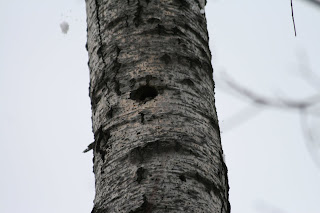
A regular cavity looks like the one on the right. If you're lucky, once you track a squirrel to its tree you can hit the tree with a stick and a squirrel will either stick its head out of the cavity or actually run out and up the tree. If you're REALLY lucky, you may even get a glide right out of the cavity to another tree. That's always fun to see :) If you look really closely, you can see the nose of a squirrel towards the bottom of the cavity circle.
 But then sometimes northerns shrug convention and do this to me. It's not new news that flying squirrels build leaf nests. It was just a little unexpected given the cold winter temperatures. Southerns do not even build leaf nests this far north. So when I stumbled upon my first nest, I thought it would likely be an outlier. But then I found more and more leaf nests...
So that brings us to this winter. This winter I collected several known leaf nests from last winter and deployed them with temperature loggers to look at the difference between outside (ambient) temperature and temperature inside the nests.
So far analysis of that temperature information shows that leaf nests are likely equivalent to tree cavities for buffering capacity. Stay tuned for more rigorous comparisons soon.
Tuesday, April 28, 2009
Students go to conferences to give talks?
Apparently. And I was under the distinct impression it was to drink entirely too many free pitchers and party grad-student style - all kidding aside, I just got back from OEEC 2009. If there's anything I know about science, it's that it LOVES acronyms.
OEEC is the Ontario Ecology and Ethology Colloquium, which was held at Queens University in Kingston this year. Students from universities from all over Ontario come together to give talks about their research or to show their research proposals. The subjects included sexual selection, climate change, population biology, environmental contamination, animal behaviour... the list goes on.
As with every conference, there were some good and some bad. Some of the interesting talks included one about nest morphologies in the yellow warbler by Vanya Rohwer at Queens University (supervisor: Paul Martin - what an unfortunate name to get stuck with). Yellow warblers make thicker and warmer nests up north than they do further south. He tested the temperature differences in these nests and found the thicker ones (which incorporated feathers and fluffy plant material) to be warmer. The thinner southern nests are more appropriate for warmer, wetter weather, which you find in southern Ontario. Whether they are locally adapted or showing plasticity remains to be seen.
Another interesting talk was about male seismic (vibration) signaling in jumping spiders by Sen Sivalinghem at University of Toronto (supervisor: Maydianne Andrade). I had no idea jumping spiders did mating dances to attract females, nor that they actually vibrated when they did them. First he classified different frequencies of vibrations, from courtship to aggressive courtship to male rivalry. Then he looked at virgin females and mated females and which behaviour the spiders exhibited to them. The males were more likely to make courtship vibrations for virgin females and aggressive courtship vibrations for mated females.
My talk went well. It was titled "Thermal properties of tree cavities in winter and implications for flying squirrels". The fact that I study flying squirrels usually helps take the edge off, and keeps people's attention (at least a little bit). Of course I spent the two days before the conference putting in 12 hour days trying to prep my talk, after assuming that the last talk I gave was "good enough". It didn't take me long to realize that I had to develop some new ways to display data when I looked at some slides that stated findings with no depictions of the results :S
Of course, I hadn't booked time with my supervisor to go over my presentation, and by the time I realized how much work I needed to do, it was Friday afternoon. And I was home. I sent my supervisor several garbled emails (to which he replied he did not understand) looking for stats explanations. Finally I broke down and called the PhD student, nearly begging for help. He walked me through my graphical dilema like a pro and I had a list of steps to create some nice depictions in no time :) Andrea:1 Procrastination: 0
Overall, the conference was interesting and good practice for the CSEE (Canadian Society of Ecology and Evolution) conference in May.
OEEC is the Ontario Ecology and Ethology Colloquium, which was held at Queens University in Kingston this year. Students from universities from all over Ontario come together to give talks about their research or to show their research proposals. The subjects included sexual selection, climate change, population biology, environmental contamination, animal behaviour... the list goes on.
As with every conference, there were some good and some bad. Some of the interesting talks included one about nest morphologies in the yellow warbler by Vanya Rohwer at Queens University (supervisor: Paul Martin - what an unfortunate name to get stuck with). Yellow warblers make thicker and warmer nests up north than they do further south. He tested the temperature differences in these nests and found the thicker ones (which incorporated feathers and fluffy plant material) to be warmer. The thinner southern nests are more appropriate for warmer, wetter weather, which you find in southern Ontario. Whether they are locally adapted or showing plasticity remains to be seen.
Another interesting talk was about male seismic (vibration) signaling in jumping spiders by Sen Sivalinghem at University of Toronto (supervisor: Maydianne Andrade). I had no idea jumping spiders did mating dances to attract females, nor that they actually vibrated when they did them. First he classified different frequencies of vibrations, from courtship to aggressive courtship to male rivalry. Then he looked at virgin females and mated females and which behaviour the spiders exhibited to them. The males were more likely to make courtship vibrations for virgin females and aggressive courtship vibrations for mated females.
My talk went well. It was titled "Thermal properties of tree cavities in winter and implications for flying squirrels". The fact that I study flying squirrels usually helps take the edge off, and keeps people's attention (at least a little bit). Of course I spent the two days before the conference putting in 12 hour days trying to prep my talk, after assuming that the last talk I gave was "good enough". It didn't take me long to realize that I had to develop some new ways to display data when I looked at some slides that stated findings with no depictions of the results :S
Of course, I hadn't booked time with my supervisor to go over my presentation, and by the time I realized how much work I needed to do, it was Friday afternoon. And I was home. I sent my supervisor several garbled emails (to which he replied he did not understand) looking for stats explanations. Finally I broke down and called the PhD student, nearly begging for help. He walked me through my graphical dilema like a pro and I had a list of steps to create some nice depictions in no time :) Andrea:1 Procrastination: 0
Overall, the conference was interesting and good practice for the CSEE (Canadian Society of Ecology and Evolution) conference in May.
Subscribe to:
Posts (Atom)